
AI agents are quickly becoming the new obsession in business technology. Every software vendor seems to be adding them. Every product deck promises autonomous workflows. Every executive conversation now includes some version of the same question: can AI agents actually improve how the business runs, or are they just another layer of hype?
The honest answer is that AI agents can create real value, but only when they are attached to real work, clear guardrails, and measurable business outcomes. When companies treat agents like a shortcut to transformation, they usually get confusion, broken workflows, and expensive experiments that never move past the demo stage.
If you are evaluating where AI agents fit into your company, this is the right place to start. This article breaks down what AI agents actually are, where they work best, what goes wrong during implementation, and how businesses can adopt them without creating unnecessary risk. If you want a broader foundation before moving into execution, TABSGI already covers related strategy topics like where to start with AI, custom AI solutions vs off-the-shelf tools, and AI development services.
What an AI Agent Really Is
Most businesses do not need a philosophical definition of agentic AI. They need a practical one. In operational terms, an AI agent is a software system that can interpret a goal, use tools or data, make limited decisions, and complete a task with some level of autonomy.
That does not mean it should run your business unattended. In most real environments, the most useful agents do not replace humans completely. They reduce repetitive effort, assemble context faster, and move work forward until a human needs to approve, correct, or escalate.
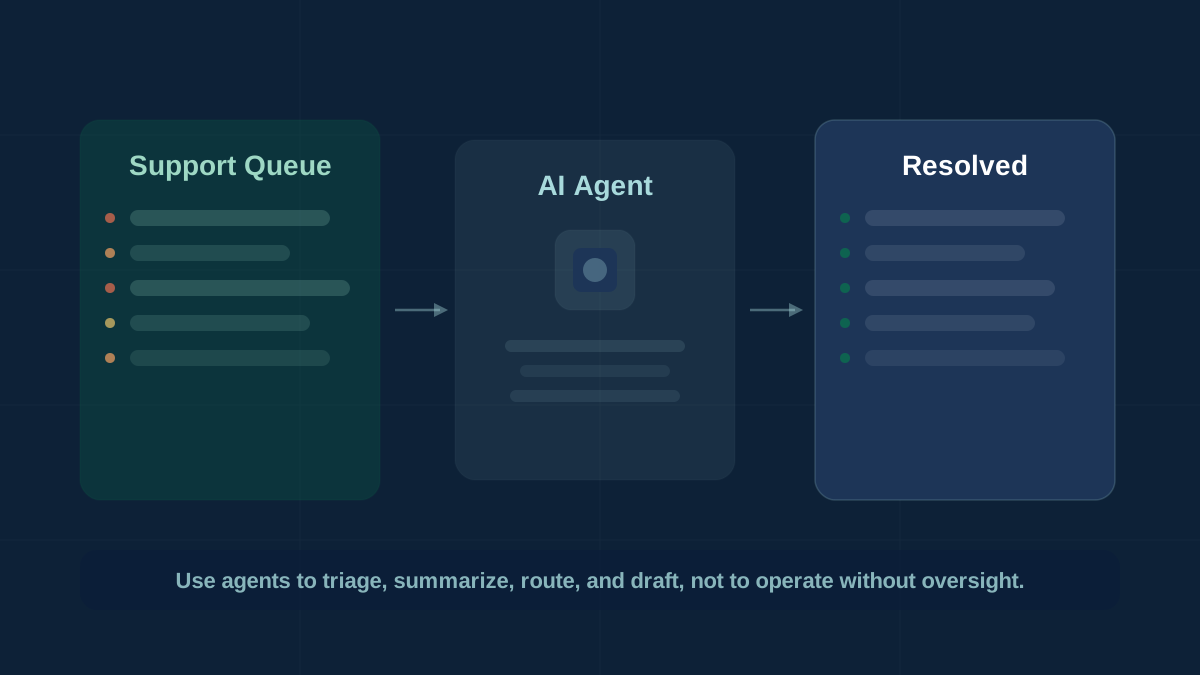
That distinction matters. The strongest business use cases are not built around the fantasy of full autonomy. They are built around controlled execution. A good AI agent can summarize incoming support tickets, retrieve customer history, draft a response, and route the issue correctly. A bad implementation gives the agent too much freedom, too little context, and no oversight.
This is why companies that already invest in custom software development, ChatGPT integrations, and DevOps are often better positioned to deploy agents successfully. They already think in systems, processes, and observability, not just features.
Where AI Agents Are Delivering Real Results
AI agents work best when the task has a clear objective, predictable inputs, access to reliable data, and some tolerance for human review. That combination exists in more places than many teams realize.
1. Customer Support Operations
Support is one of the clearest early wins. Agents can classify tickets, detect urgency, pull account details, suggest resolutions, and prepare drafts for human support teams. This reduces time-to-response without forcing businesses to hand over the entire customer relationship to a machine.
It also aligns with a broader trend discussed in AI chatbots that actually work. The business value does not come from sounding clever. It comes from faster triage, fewer handoff delays, and better access to historical context.
2. Internal Knowledge Retrieval
Many companies lose time because information is scattered across CRMs, Slack threads, email, policy documents, and product documentation. An AI agent connected to internal knowledge sources can help teams locate answers faster, reduce duplicate questions, and shorten onboarding cycles.
This is especially useful in operations, sales engineering, HR, and project delivery. Instead of asking five people where a file lives or which version of a document is current, teams can query a controlled system that references approved sources.
3. Sales and Proposal Workflows
Sales teams deal with repeatable tasks all day: qualifying leads, preparing summaries, drafting outbound messaging, and organizing meeting context. AI agents can reduce the time spent on administrative work so sales teams can focus on conversations and decision-making.
For service businesses, this can extend into proposal generation, qualification scoring, and solution recommendation. But the best results come when agents work from structured rules, pricing boundaries, and approved service definitions, not raw improvisation.
4. Operations and Back-Office Execution
Back-office workflows often contain the exact kind of repeatable steps that agents can improve. Think invoice checks, document validation, onboarding paperwork, scheduling coordination, procurement summaries, or compliance reminders. These tasks often involve multiple systems and a large amount of manual follow-up, which makes them ideal for carefully scoped automation.
When paired with the right integrations, agents can act like intelligent coordinators. They do not just respond to prompts. They move data, flag exceptions, and keep processes from stalling.
Why So Many AI Agent Projects Fail
The reason is not usually the model. It is the operating environment around the model.
Companies often underestimate how much discipline is required to make AI agents dependable. They assume the hard part is choosing the right vendor or model. In reality, the hard part is designing the surrounding workflow correctly.
Here are the most common failure points:
- Unclear goals: The team cannot define what success looks like beyond “use AI.”
- Poor data access: The agent cannot reach trusted, structured, current information.
- No process mapping: Nobody identified where the agent should act, stop, or escalate.
- Weak governance: There are no permissions, approval rules, or audit trails.
- Too much autonomy too early: The business gives agents decision rights before validating performance.
This is also why AI agent projects should not be framed as isolated experiments from the product or operations team. They are cross-functional systems. They involve UX, security, infrastructure, workflows, and change management. That is one reason businesses often work with firms that combine UI/UX design, web development, and AI implementation under one delivery model.
The Smart Way to Introduce AI Agents
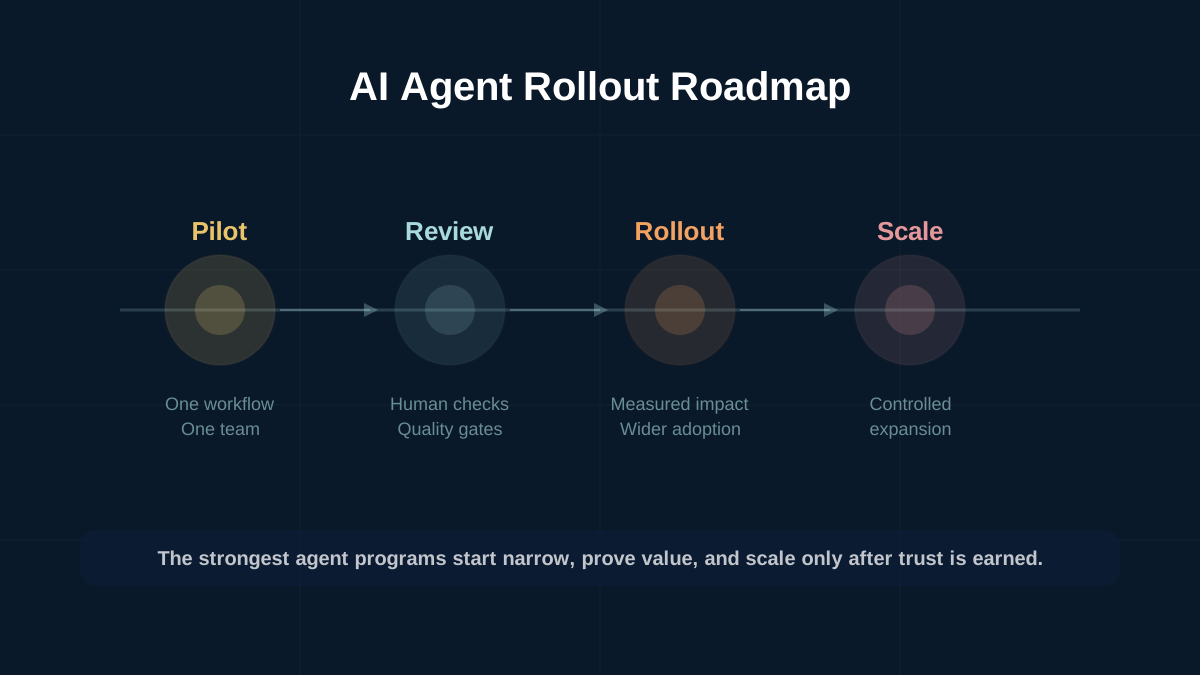
Businesses that succeed with AI agents usually follow a much less dramatic path than the market suggests. They start with one contained workflow. They define measurable outcomes. They keep humans involved. Then they expand only after the system proves it can handle real-world complexity.
Start With a Single Workflow
Choose one task where the pain is obvious and the business case is easy to explain. It might be support triage, internal knowledge search, appointment coordination, or proposal preparation. The narrower the first use case, the faster you can learn.
Avoid starting with a vague goal like “build an AI agent for the company.” That is not a use case. That is a budget sink.
Design for Human Review
The highest-performing implementations treat AI agents like operational co-pilots. They prepare, recommend, draft, summarize, and route. Humans still approve key actions, especially when customer communication, compliance, payments, or sensitive records are involved.
This approach makes adoption easier internally too. Teams are more willing to use AI when they understand that they are not surrendering control. They are gaining leverage.
Measure Operational Outcomes
Do not evaluate your agent by whether it sounds impressive. Evaluate it by whether it improves the process. Good metrics include resolution time, handling cost, turnaround speed, lead qualification time, documentation accuracy, and escalation quality.
If the process does not improve, the implementation is not working, even if the demo looks polished.
Build the Data Layer First
Agents become unreliable when they work with incomplete or conflicting context. Before expanding automation, make sure the system has access to current documents, approved policies, correct customer records, and clear role-based permissions.
This part is less exciting than prompt engineering, but it is where the real stability comes from. Without it, your agent will produce answers that sound confident and still damage trust.
Build vs Buy: What Businesses Should Actually Consider
There is no universal right answer between buying a ready-made tool and building a custom agent workflow. The right choice depends on how standard your process is, how sensitive your data is, and how much control you need over the user experience.
| Decision Factor | Buy an Off-the-Shelf Tool | Build a Custom Agent |
|---|---|---|
| Speed to launch | Usually faster for basic workflows | Slower initially, better fit long term |
| Workflow flexibility | Limited to product constraints | Designed around your exact process |
| Integration depth | Often restricted | Can match internal systems closely |
| Data control | Depends on vendor policies | Higher control and stronger governance |
| Competitive differentiation | Low if competitors use the same tool | Higher if workflow execution is strategic |
If your use case is simple and generic, buying can be smart. If the process is core to how your business delivers value, custom development usually becomes the better long-term investment. TABSGI explores that exact trade-off in Custom AI Solutions vs Off-the-Shelf.
Security, Compliance, and Trust Cannot Be Added Later
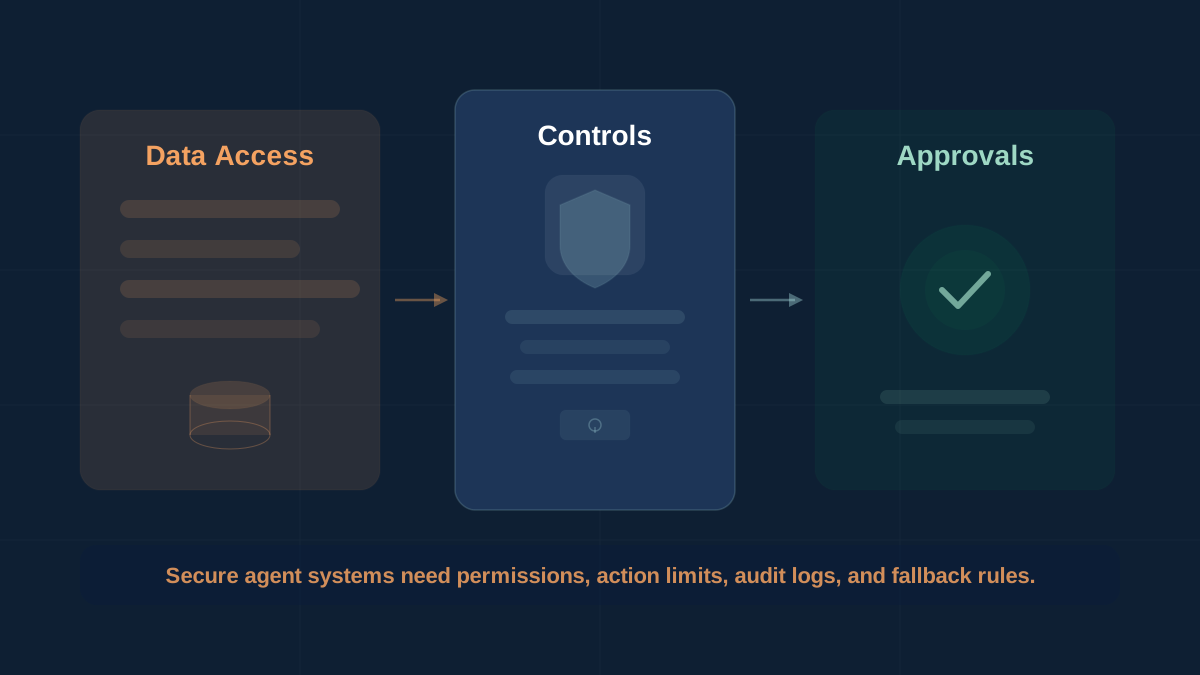
As businesses move from AI assistants to AI agents, the risk profile changes. The system is no longer just generating content. It may be accessing documents, triggering workflows, updating records, or interacting with customers. That makes governance essential.
At minimum, businesses should define:
- Access boundaries: What systems and records can the agent see?
- Action limits: What can it do without human approval?
- Auditability: Can you trace what happened and why?
- Fallback paths: What happens when confidence is low or an exception appears?
- Review standards: Who is accountable for accuracy and policy alignment?
Frameworks from organizations like NIST and guidance from enterprise cloud providers can help define safer deployment practices. But strategy still needs to be translated into implementation. Governance only matters when it is reflected in the product and workflow design.
Questions to Ask Before You Invest
Before approving an AI agent initiative, leadership teams should be able to answer a few direct questions:
- What specific business problem are we solving?
- Which workflow will improve first?
- What data will the agent use?
- How will success be measured?
- Where does human approval remain mandatory?
- Do we need a packaged tool, a custom solution, or a hybrid approach?
If those answers are unclear, the project is probably not ready. That does not mean the business should stop. It means the next step is discovery, not deployment.
Final Thoughts
AI agents are not the future because they are trendy. They matter because they can turn fragmented workflows into coordinated execution, when they are designed properly. The companies that benefit most will not be the ones that automate the most. They will be the ones that automate the right things, with the right controls, at the right pace.
For many businesses, the best first move is not a giant transformation program. It is one carefully chosen workflow, one well-defined pilot, and one implementation partner that understands both the technology and the business process behind it.
If your team is exploring practical AI adoption, start with strategy and execution together. Review TABSGI resources on business use cases for AI engineers, starting small with AI, and contacting TABSGI for custom AI planning and delivery.