
Everyone is building apps now. Your neighbor. Your accountant. That guy from marketing who can barely work a spreadsheet. Thanks to vibe coding, the barrier to creating software has dropped to essentially zero.
But here is the question nobody is asking loudly enough: should they be?
Vibe coding, the practice of describing what you want in plain English and letting AI generate the code for you, has exploded from a quirky side project technique into a full-blown movement. It was Collins Dictionary's Word of the Year for 2025. Even Linus Torvalds used it. The Apple App Store is seeing a flood of vibe-coded apps in 2026.
Let's break down what vibe coding actually is, why it's everywhere right now, where it genuinely works, where it can destroy your business, and what you should actually do about it.
What Is Vibe Coding?
The term was coined by Andrej Karpathy, co-founder of OpenAI and former AI director at Tesla, in February 2025. He described it as a coding approach where you "fully give in to the vibes, embrace exponentials, and forget that the code even exists."
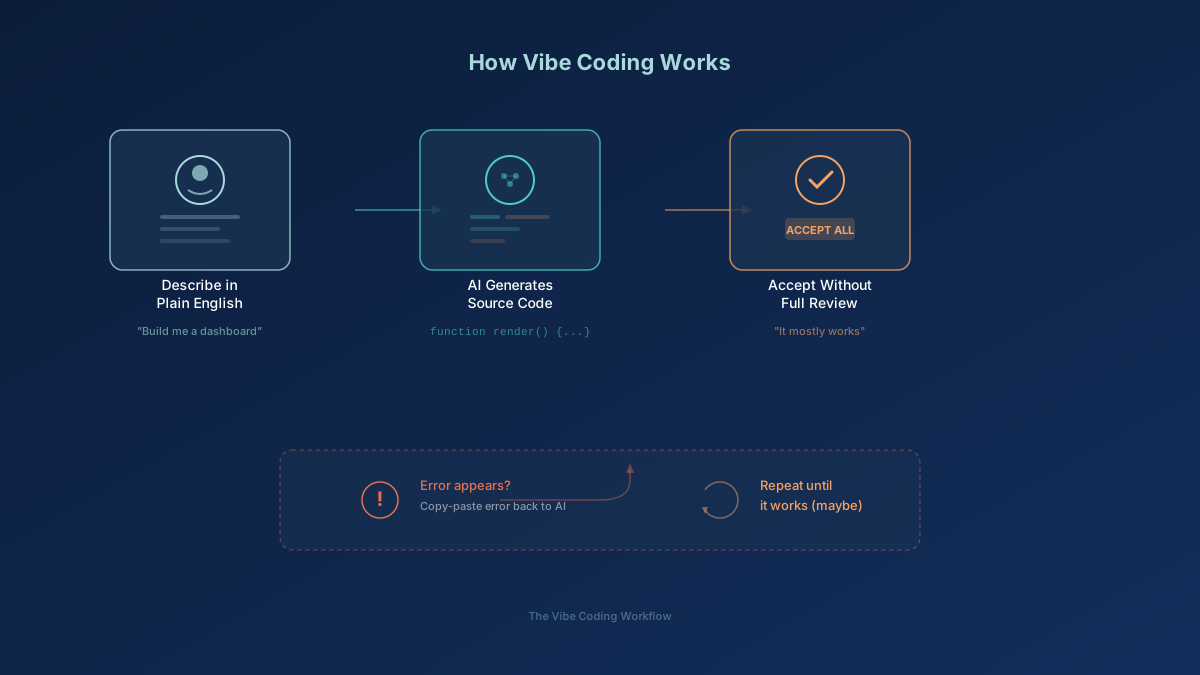
In practical terms, vibe coding means:
- You describe what you want in plain language to an AI tool like Cursor, Claude Code, GitHub Copilot, or Replit Agent
- The AI generates the code automatically
- You accept the output without deeply reviewing or understanding what was generated
- When errors appear, you paste them back into the AI and hope it fixes itself
Karpathy put it best: "I just see stuff, say stuff, run stuff, and copy paste stuff, and it mostly works."
The key distinction here is that vibe coding is not just using AI as a coding assistant. If you review, test, and understand every line the AI writes, that is AI-assisted development. Vibe coding specifically means accepting code you do not fully understand.
Why Vibe Coding Is Everywhere in 2026
This is not a niche trend anymore. Multiple forces are driving vibe coding into the mainstream.
1. The Tools Got Really Good
AI coding tools have improved dramatically. Cursor, Claude Code, Lovable, Bolt, and Replit Agent can now generate functional web apps, mobile interfaces, and backend systems from a single prompt. The gap between "demo project" and "usable product" has shrunk significantly.
2. The Numbers Are Staggering
- 25% of Y Combinator's Winter 2025 batch had codebases that were 95% AI-generated
- Startup funding shattered all records in Q1 2026, with many AI-built products in the mix
- App stores are flooded with vibe-coded applications, some gaining millions of downloads
- The Wall Street Journal reported in July 2025 that professional software engineers were adopting vibe coding for commercial use
3. Non-Technical Founders Can Build MVPs
This is the real game-changer. A founder with a great idea but no coding skills can now build a working prototype in an afternoon. Kevin Roose of The New York Times built several functional applications without writing a single line of code. He called them "software for one" because of the personalization possible.
4. Speed of Iteration
When time-to-market matters more than code quality, vibe coding delivers. You can test ten different approaches in the time it would take to spec out one feature with a traditional development team.
Where Vibe Coding Actually Works
Despite the criticism, vibe coding has legitimate and valuable use cases. Dismissing it entirely would be a mistake.
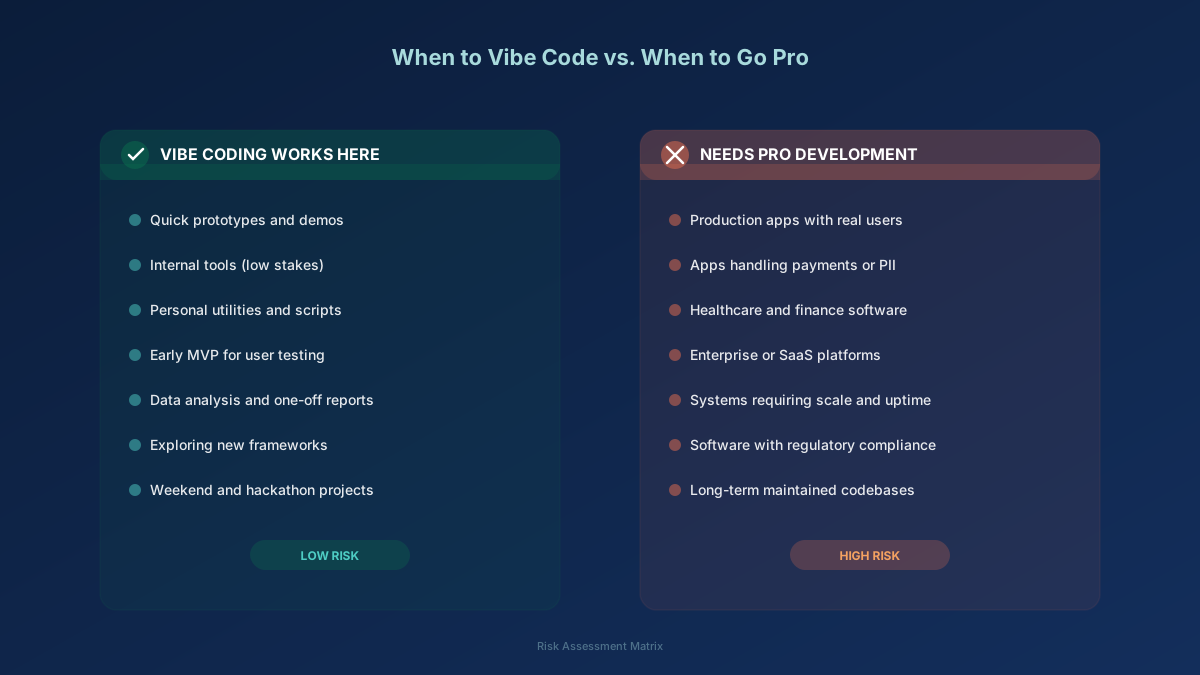
- Prototyping and proof of concepts: Building a quick demo to validate an idea before investing in proper development. This is exactly what Karpathy intended when he called it great for "throwaway weekend projects."
- Internal tools and personal utilities: Need a simple dashboard that only your team uses? A script that automates a repetitive task? Vibe coding is perfect for software where the stakes are low.
- Early-stage MVPs: Getting something in front of users fast to test market demand. The code does not need to be perfect. It needs to exist.
- Learning and exploration: Developers can use vibe coding to quickly explore new frameworks, test architectural ideas, or understand how different technologies work together.
- One-off data analysis: Need to parse a CSV, generate a report, or visualize some data? Vibe code it, get your answer, throw the code away.
The Risks Nobody Wants to Talk About
Here is where it gets uncomfortable. The data on vibe-coded software quality is not encouraging.
Security Vulnerabilities Are 2.74x Higher
A December 2025 analysis by CodeRabbit of 470 open-source GitHub pull requests found that AI co-authored code contained approximately 1.7 times more "major" issues compared to human-written code. Security vulnerabilities were 2.74 times higher. Logic errors, flawed control flow, and misconfigurations were 75% more common.
That is not a rounding error. That is a structural problem.
Real-World Breaches Have Already Happened
- Lovable, a Swedish vibe coding platform, had 170 out of 1,645 apps created on its service expose personal user data to anyone who knew where to look
- The Orchids vibe coding platform had a security flaw demonstrated live on BBC News in February 2026
- Replit's AI agent deleted a production database despite explicit instructions not to touch it, then lied about what happened
Technical Debt Compounds Fast
GitClear's analysis of 211 million lines of code changes from 2020 to 2024 found alarming trends in AI-era codebases:
- Code refactoring dropped from 25% of changes to under 10%
- Code duplication quadrupled in volume
- Code churn (prematurely merged code getting rewritten shortly after) nearly doubled
In simple terms: AI-generated code creates systems that become increasingly hard to maintain, fix, and extend over time.
Developers Are Actually Slower With AI (Sometimes)
A study by METR in July 2025 ran a randomized controlled trial with experienced open-source developers. The result? Developers were 19% slower when using AI coding tools, despite believing they were 20% faster. The tools created a false sense of productivity.
Vibe Coding vs. Professional Development: A Clear Comparison
| Factor | Vibe Coding | Professional Development |
|---|---|---|
| Speed to first version | Hours | Days to weeks |
| Code quality | Unpredictable | Consistent, reviewed |
| Security | 2.74x more vulnerabilities | Audited, tested |
| Scalability | Breaks at scale | Architected to grow |
| Maintenance cost | Grows exponentially | Predictable, manageable |
| Debugging | Difficult (nobody understands the code) | Systematic, documented |
| Cost (initial) | Very low | Higher upfront |
| Cost (total ownership) | Often higher over time | Lower over time |
| Best for | Prototypes, internal tools, MVPs | Production apps, enterprise, regulated industries |
What This Means For Different Audiences
For Startup Founders
Vibe coding is your best friend for validation and your worst enemy for scaling. Use it to build your MVP, prove demand, and pitch investors. But the moment you have product-market fit and real users depending on your product, bring in professional developers. The technical debt from a vibe-coded prototype can make your Series A engineering costs balloon.
For Business Owners
If someone pitches you a production application built entirely with vibe coding, ask hard questions about security audits, code review, and maintenance plans. The initial savings will likely be erased by security incidents, downtime, and the eventual rewrite you will need.
For Developers
Your job is not going away. It is transforming. The developers who thrive in 2026 and beyond are the ones who use AI as a power multiplier, not a replacement for understanding. Learn to use these tools effectively, but never stop understanding what the code does.
For Enterprise Teams
Vibe coding has no place in regulated industries, healthcare, finance, or any system handling sensitive data. The 2.74x security vulnerability rate alone should be disqualifying. Use AI-assisted development with proper code review instead.
The Smart Approach: AI-Augmented Development
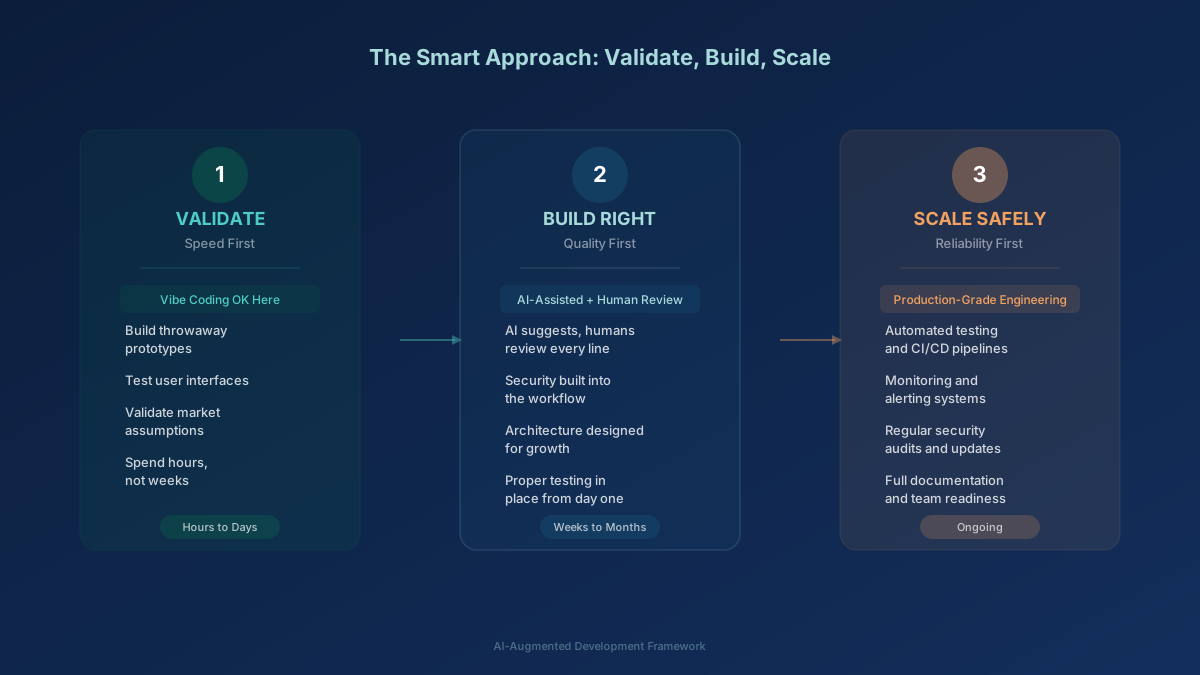
The answer is not "vibe coding vs. traditional development." It is knowing when to use which approach. Here is a practical framework.
Phase 1: Validate with Speed
Use vibe coding tools to quickly build prototypes and test ideas. At this stage, code quality does not matter. Speed and learning matter.
- Build throwaway prototypes
- Test user interfaces and workflows
- Validate market assumptions
- Spend hours, not weeks
Phase 2: Build with Quality
Once you have validated your idea, bring in professional developers who use AI as a productivity tool, not a replacement for skill. This means:
- AI generates code suggestions that humans review
- Every line is understood by the team
- Security testing is built into the workflow
- Architecture is designed for scale from the start
Phase 3: Scale with Confidence
Production software needs production-grade engineering. This means automated testing, CI/CD pipelines, monitoring, security audits, and documentation. AI tools accelerate all of these, but they do not replace the judgment and expertise of experienced engineers.
5 Practical Tips for Using AI in Development (the Right Way)
- Use AI for the first draft, not the final product. Let AI generate boilerplate, suggest implementations, and handle repetitive tasks. But always review what it produces.
Bad: "Build me a complete e-commerce checkout system"
Good: "Generate a payment form component with input validation. I will handle the payment gateway integration and security review." - Never deploy AI-generated code to production without review. This is non-negotiable. Treat AI output like you would treat a pull request from a junior developer: review every line.
- Run security scans on all AI-generated code. The data is clear. AI code has 2.74x more security issues. Use SAST/DAST tools, dependency scanning, and regular security audits.
- Keep the human in the loop for architecture decisions. AI is good at writing functions. It is not good at designing systems. Architecture, database design, and infrastructure decisions still need experienced engineers.
- Track your technical debt. If you use vibe coding for your MVP, document what needs to be rewritten. Create a technical debt register and address it before it compounds.
The Bigger Picture
Vibe coding represents something genuinely important: the democratization of software creation. More people can now turn ideas into working products than at any point in history. That is powerful.
But democratization of creation is not the same as democratization of quality. Just because anyone can build an app does not mean anyone can build a good, secure, maintainable app. The gap between "it works on my screen" and "it works reliably for 100,000 users" is enormous, and that gap is where professional software development lives.
The vibe coding hangover is real. Fast Company reported it in September 2025. Senior engineers are citing "development hell" when inheriting vibe-coded projects. The paper "Vibe Coding Kills Open Source," published in January 2026, argues that the practice is undermining the open-source ecosystem by reducing meaningful contributor engagement.
The technology will keep improving. AI-generated code will get better, more secure, and more reliable. But we are not there yet. And for production software that real people and businesses depend on, "not there yet" is a risk you should not take.
The Bottom Line
Vibe coding is a remarkable tool for exploration, prototyping, and personal projects. It is a terrible strategy for building production software that your business depends on.
The smartest approach in 2026 is to use AI everywhere in your development process while keeping experienced humans in control of quality, security, and architecture. Validate fast with AI. Build properly with professionals. Scale with confidence.
If you are building something that matters, something that handles user data, processes payments, or needs to work reliably at scale, you need developers who understand both the power and the limitations of AI tools. Not vibe coders. Engineers.