
Two years ago, building custom software meant months of planning, a full dev team, and a budget that made most founders wince. That world is gone.
In 2026, artificial intelligence has fundamentally changed how custom software gets built. Not in a marketing-buzzword kind of way. In a "we just shipped in three weeks what used to take four months" kind of way.
Whether you are a startup founder, a CTO at a mid-size company, or a developer trying to stay relevant, this shift affects you directly. Let's break down exactly what has changed, what is real versus hype, and how companies like TabsGI are using AI to deliver custom software faster than ever.
The Old Way vs. The New Way
Let's start with the uncomfortable truth. Traditional custom software development was slow. Not because developers were lazy, but because the process was inherently complex.
The traditional workflow looked like this:
- Requirements gathering: 2 to 4 weeks of meetings and documents
- Architecture design: another 2 to 3 weeks of planning
- Development sprints: 8 to 16 weeks of coding, testing, fixing
- QA and deployment: 2 to 4 more weeks
- Total: 3 to 6 months for a moderately complex application
The 2026 AI-assisted workflow looks radically different:
- AI-accelerated discovery: 1 week. AI analyzes requirements, generates user stories, identifies edge cases automatically
- Rapid prototyping: 1 to 2 weeks. AI generates working prototypes from specifications
- AI pair programming: 3 to 6 weeks. Developers work alongside AI to build production code
- Automated testing and deployment: 1 week. AI generates test suites and CI/CD pipelines
- Total: 6 to 10 weeks for the same application
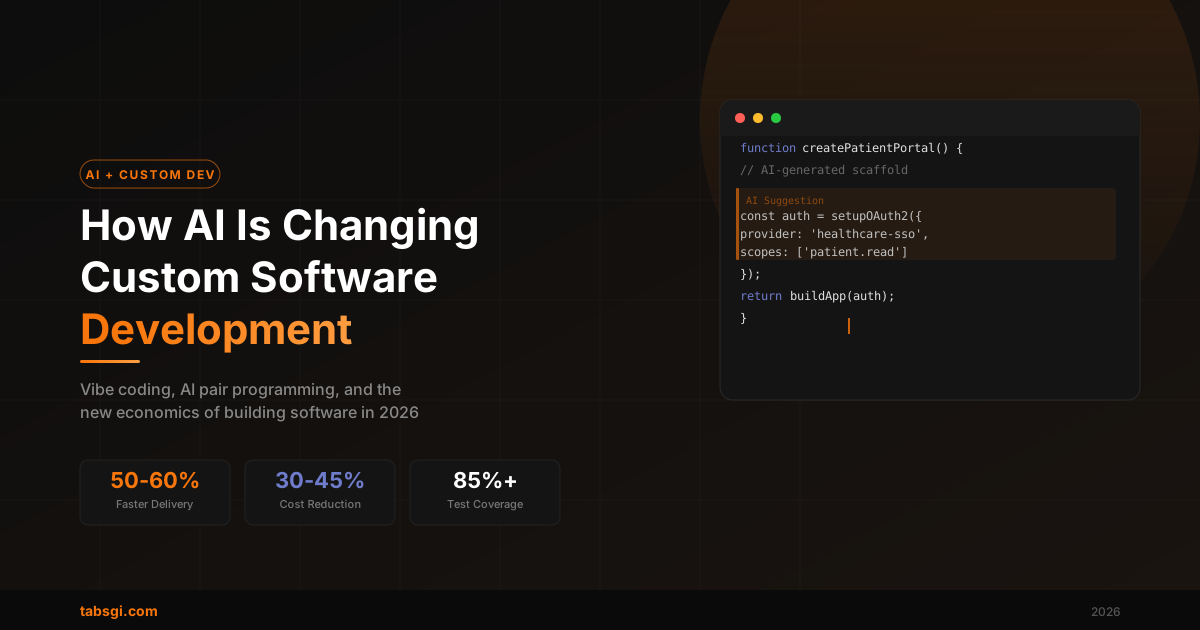
That is not a marginal improvement. That is a 50 to 60 percent reduction in delivery time. And it is happening right now, across every industry.
What AI Actually Does in Modern Development
There is a lot of noise about AI in software development. Let's cut through it and talk about what is genuinely useful today.
1. AI Pair Programming
This is the biggest shift. Tools like GitHub Copilot, Cursor, and Claude Code now function as genuine coding partners, not just autocomplete on steroids.
A senior developer using AI pair programming in 2026 can:
- Write boilerplate code 5 to 10 times faster
- Generate database schemas from natural language descriptions
- Scaffold entire API endpoints in minutes instead of hours
- Refactor legacy code with AI-suggested improvements
- Debug complex issues by having AI analyze stack traces and logs
The key word here is "senior developer." AI pair programming works best when the human understands the code well enough to review, correct, and guide what the AI produces. This is not about replacing developers. It is about making good developers dramatically faster.
2. Vibe Coding for Prototypes and MVPs
Vibe coding, where you describe what you want in plain English and let AI generate the code, has its place. For rapid prototyping, internal tools, and proof-of-concept applications, it is genuinely powerful.
Where vibe coding works well:
- Internal dashboards: Quick admin panels that only your team uses
- Proof of concept: Showing stakeholders what an app could look like before investing in proper development
- Data scripts: One-off data processing, migration scripts, report generators
- Landing pages: Marketing pages that need to ship fast
Where vibe coding falls apart:
- Production applications: Security, performance, and maintainability require human expertise
- Complex business logic: AI struggles with nuanced domain rules
- Regulated industries: Healthcare, finance, and legal software needs human oversight
- Scalability: Vibe-coded apps often hit walls when traffic grows
The smart approach is using vibe coding for speed in the early stages, then bringing in professional developers to harden the code for production.
3. AI-Generated Testing
This might be the most underrated change in 2026. Writing tests has always been the part developers skip or rush through. AI has changed that equation.
Modern AI testing tools can:
- Generate unit tests automatically from your codebase
- Create integration test scenarios based on API documentation
- Write end-to-end tests from user stories
- Identify edge cases that human testers miss
- Maintain test suites as code changes
At TabsGI, AI-generated tests have increased our test coverage from an industry-average 40 percent to over 85 percent on new projects, without adding time to the development cycle.
4. Intelligent Code Review
AI-powered code review catches issues that human reviewers often miss. Security vulnerabilities, performance bottlenecks, accessibility problems, and code style inconsistencies are flagged automatically before any human reviewer sees the code.
This does not replace human code review. It makes human review more valuable because reviewers can focus on architecture decisions and business logic instead of catching syntax errors and obvious bugs.
Real Numbers: How AI Changes Project Economics
Let's talk money, because this is where it gets interesting for business decision-makers.
Here is what we are seeing across projects at TabsGI in 2026:
- Development speed: 40 to 60 percent faster delivery timelines
- Cost reduction: 30 to 45 percent lower project costs
- Bug density: 35 percent fewer production bugs with AI-assisted testing
- Code quality: Measurably better code consistency across team members
- Developer satisfaction: Higher retention because developers work on interesting problems, not boilerplate
A concrete example: a healthcare client came to us needing a custom patient portal with appointment scheduling, medical record access, and secure messaging. Traditional estimate: 16 weeks, $120,000. With AI-assisted development: 8 weeks, $72,000. Same quality, same security standards, half the time and cost.
The Tools Powering This Shift
If you are a developer or tech leader, these are the AI tools that matter most in 2026:
- GitHub Copilot: The most widely adopted AI coding assistant. Excels at code completion, function generation, and test writing. Works across all major editors.
- Cursor: An AI-first code editor that understands your entire codebase. Great for large projects where context matters.
- Claude Code: Anthropic's coding agent that can plan, execute, and iterate on complex coding tasks autonomously.
- Replit Agent: Best for rapid prototyping and MVPs. Handles full-stack app generation from descriptions.
- Windsurf: Strong at understanding project architecture and making cross-file changes.
- v0 by Vercel: Specialized in UI/frontend generation. Produces production-ready React components.
No single tool does everything well. The best development teams in 2026 use a combination, choosing the right tool for each stage of the project.
How TabsGI Uses AI to Deliver Faster
At TabsGI, AI is integrated into every stage of our development process. Here is exactly how:
Discovery Phase
We use AI to analyze client requirements, generate comprehensive user stories, and identify potential technical challenges before a single line of code is written. This cuts our discovery phase from two weeks to three to five days.
Architecture and Design
AI helps us evaluate architecture options, generate database schemas, and create API specifications. Our architects still make the final decisions, but AI provides the analysis and options 10 times faster than manual research.
Development
Every developer on our team uses AI pair programming daily. Boilerplate code, CRUD operations, data validation, and standard patterns are AI-generated and human-reviewed. Developers focus their expertise on complex business logic, performance optimization, and security hardening.
Testing
AI generates our initial test suites. Developers review and enhance them with domain-specific edge cases. The result is comprehensive testing that would have been too time-consuming to write manually.
Deployment
AI assists with CI/CD pipeline configuration, infrastructure-as-code generation, and deployment scripting. What used to be a specialized DevOps task is now faster and more reliable.
The result? We deliver custom software 40 to 60 percent faster than we did two years ago, at lower cost, with better quality. That is not marketing. That is what AI-assisted professional development actually delivers.
What This Means for Your Business
If you have been putting off building custom software because of cost, timeline, or complexity concerns, the calculus has changed. Here is what you should know:
For Startup Founders
- Custom MVPs are now affordable. Budget $30,000 to $50,000 instead of $80,000 to $150,000.
- Time to market is measured in weeks, not months.
- You can validate faster and iterate cheaper than ever before.
For CTOs and Tech Leaders
- Your existing dev team can output significantly more with AI tooling.
- Training your team on AI pair programming is the highest-ROI investment you can make right now.
- Consider hybrid approaches: vibe coding for prototypes, professional development for production.
For Non-Technical Founders
- Do not try to vibe-code your production app yourself. The cost of fixing bad code later is 3 to 5 times higher than building it right the first time.
- Do use AI tools to create mockups and prototypes to communicate your vision to developers.
- The barrier to entry for custom software has dropped, but the need for professional expertise has not.
Common Misconceptions
Let's clear up some things that are getting lost in the AI hype:
"AI will replace developers." No. AI replaces the tedious parts of development. The demand for skilled developers who can guide AI, architect systems, and solve complex problems is actually increasing.
"AI-generated code is always low quality." Not anymore. When guided by experienced developers, AI-generated code is often cleaner and more consistent than fully manual code. The key is human oversight.
"Vibe coding means anyone can build production software." Absolutely not. Vibe coding is great for prototypes and simple tools. Production software serving real users needs security, scalability, error handling, and maintainability that require professional expertise.
"AI makes custom software the same as off-the-shelf." The opposite. AI makes custom software more accessible because it costs less and ships faster. The advantage of custom over off-the-shelf is stronger than ever.
What Comes Next
The pace of improvement in AI coding tools is accelerating. Here is what we expect to see in the next 12 to 18 months:
- Full-stack AI agents: AI that can handle entire features from specification to deployed code, with human approval gates
- AI-native testing: Continuous, automated testing that evolves with your codebase
- Smarter debugging: AI that monitors production systems and suggests fixes before issues become outages
- Cross-platform generation: Write once, deploy everywhere. AI handling the platform-specific adaptations
The companies adopting AI-assisted development now are building a compounding advantage. Every project makes their teams faster, their processes more refined, and their delivery more predictable.
Getting Started
If you are ready to take advantage of AI-powered custom software development, here are your next steps:
- Audit your current tools. Are your developers using AI pair programming? If not, start there. The ROI is immediate.
- Rethink your project timelines. If you received a 4-month estimate last year, get a new quote. AI-assisted teams deliver significantly faster.
- Start with a pilot project. Pick one internal tool or customer-facing feature and build it with an AI-equipped development partner.
- Measure the difference. Track speed, cost, quality, and developer satisfaction. The numbers will speak for themselves.
The bottom line: AI has not made custom software development easy. It has made it faster, cheaper, and more accessible. The companies that recognize this shift and act on it now will have better tools, happier teams, and a real competitive edge over those still doing things the old way.
Ready to see what AI-powered custom development can do for your project? Talk to our team at TabsGI and let's build something that actually fits your business.